
Skip to content

Clear communicationFree inspections

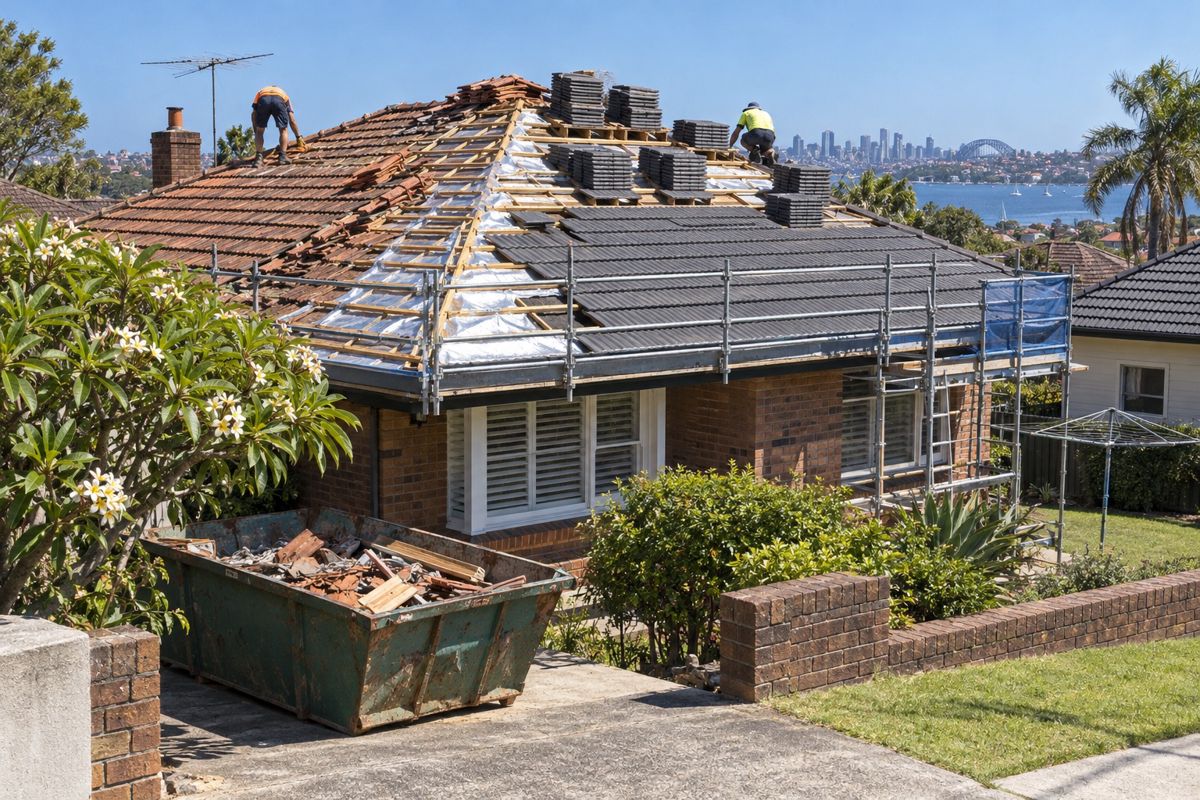
Old tiles being stripped and new tiles laid on a Sydney house

Roof replacement in Sydney

Roof replacement in Sydney: what to expect before you start

A new roof is a big decision. Here is how the work runs, what drives the cost and when replacing makes more sense than repairing.

  • Tile and Colorbond re-roofs
  • Quoted in writing before work starts
  • Clear scope, no jargon

Step 1 of 3

What do you need?

What does a roof replacement in Sydney involve?

A roof replacement means stripping the old covering and fitting a new one. On a typical Sydney house that starts with erecting edge protection or scaffolding, then removing the old tiles or sheets, checking the battens or purlins and rafters underneath, and repairing anything that is rotted or damaged.

Next comes the new layers. That usually includes sarking or a sisalation membrane under the roof covering, new battens, flashings at walls, chimneys and valleys, then the tiles or metal sheeting itself. Ridge capping and gutters are dealt with at the same time, because it makes little sense to put a new roof under tired gutters.

Every roof is different. A simple gable roof on a single-storey brick house is a very different job to a multi-pitched terrace with a parapet and a box gutter.

Which roofing material suits a Sydney home?

The right material depends on the house, the street and your budget. These are the common choices.

  • Concrete tiles. Widely used on suburban homes from the 1980s onwards. Heavy, durable and available in many colours.
  • Terracotta tiles. Found on Federation and inter-war houses. They hold their colour well but cost more to supply and fit.
  • Colorbond steel. Light, fast to install and common on renovations. A coastal grade is worth asking about near the water.
  • Slate. Seen on some older and heritage homes. Specialist work.

Think about the structure

Tile is heavy. Switching from metal to tile, or the other way round, can mean changes to the framing, so it is worth checking before you decide. In a heritage conservation area, changing the material on a street-facing roof may also need council consent.

What changes the price of a new roof?

We do not publish prices here because every roof is different. These are the things that move a quote up or down.

  • Roof size and shape. More hips, valleys, dormers and penetrations mean more labour.
  • Material. Terracotta and slate cost more than concrete tile or steel.
  • Condition of the timber below. Rot, termite damage or poor framing adds repair work.
  • Access. Narrow terrace lanes, steep blocks and no room for a skip bin all add time.
  • Extras. New gutters, downpipes, insulation, skylights and gutter guards for bushfire-prone areas.
  • Old roof removal. Roofs from before the mid-1980s may contain asbestos cement sheeting, which needs licensed removal and disposal and costs more.

A written quote that lists these items separately is easier to compare. A roof inspection before you ask for quotes can help you understand what is really needed.

Many ordinary houses take from a few days to a couple of weeks once work begins. Large or complex roofs, heritage work and jobs held up by rain take longer. Sydney weather matters here, because an open roof has to be covered every night and rain days are often lost.

What happens on the day

Expect noise, a skip bin or trailer, ladders and scaffolding, and crews on site from early in the morning. Move cars and outdoor furniture away from the house, and let your neighbours know. Tiles and old materials are removed in sections, so the house is covered as the work moves across the roof.

At the end there should be a walk-through, a magnet sweep of the yard for stray nails and a clean tidy site. Ask for the details in writing at quote stage, including who looks after waste removal.

When should you replace instead of repair?

Repair is usually right when the damage is local and the rest of the roof is in decent shape, such as a few cracked tiles or a failed flashing. See our page on roof repair in Sydney for how that works.

Replacement starts to make sense when tiles are crumbling or porous, when metal sheets are rusting through, when leaks keep returning in different places or when the battens and sarking have failed. Another trigger is cost. If repair bills keep adding up, a new roof may be better value over time.

If you are unsure, start with an inspection and a written report. You can then compare repairing with replacing using real information. When you are ready to talk about a new roof, head back to the home page to get in touch.

What you can expect

1

Clear communication

2

Free inspections

3

Written estimates

4

Local crew

Request roof replacement

Tell us what you need and we call you back.

Step 1 of 3

What do you need?

No obligation.

Questions about roofing in Sydney

How do I know if my roof needs replacing?

Common signs include widespread cracked or crumbling tiles, rusted or lifting metal sheets, sagging sections, daylight showing in the roof space and leaks that keep returning after repairs. A written inspection report is the best way to find out. It should tell you whether repair or replacement is the sensible option.

Do I need council approval for a new roof in Sydney?

It depends. Like-for-like replacement is often treated as minor work, but changing the material, colour or pitch, or working in a heritage conservation area or bushfire-prone zone, may need approval. Check with your local council or a private certifier before work starts. Your contractor should also be able to point you in the right direction.

Can I stay in the house during a roof replacement?

Most people do. It will be noisy and the property will be busy with crews and equipment. If you work from home, have young children or have pets, plan around the busiest days. Ask your roofer to explain the stages so you know when removal is happening and the house is most exposed.

What should be in a roof replacement quote?

A good quote lists the material and brand, the scope of work, what is done with the old roof and waste, flashings, gutters and ridge capping, any allowance for timber repairs, and the payment terms. It should also say what happens if hidden damage is found. Vague one-line quotes are hard to compare.

Is old asbestos roofing still a problem in Sydney?

It can be. Many houses built before the mid-1980s used asbestos cement sheeting on roofs, sheds and extensions. Do not drill, cut or break it. Removal rules are strict and often require a licensed removalist. If you are not sure what your roof is made of, ask a qualified person to check before work starts.

How it works

  1. Step 1

    Call or request a quote

    Tell us what is happening with the roof.

  2. Step 2

    Free inspection

    A roofer checks the roof and gives a written price.

  3. Step 3

    Work done right

    Clean crew, nail sweep, warranty in writing.

Ready when you are

Call now or request a quote online.

(02) 5550 8665